


Looking ahead to the rest of 2026, the Clarity Act stands out as a pivotal legislative milestone for the virtual asset market.
The Clarity Act (officially the Digital Asset Market Clarity Act), introduced in 2025 by French Hill, Chairman of the US House Financial Services Committee, aims to establish a definitive framework for virtual assets—whose legal status has long been ambiguous—and assign clear regulatory oversight responsibilities. The legislation seeks to resolve the longstanding jurisdictional dispute between the US Securities and Exchange Commission (SEC) and the Commodity Futures Trading Commission (CFTC). Should the Clarity Act pass, it would mark a watershed moment in the institutionalisation of the US cryptocurrency market.
What exactly is the Clarity Act?
The core provisions of the Clarity Act establish defined categories for virtual assets and assign their respective regulatory authorities. In simple terms, the US Commodity Futures Trading Commission (CFTC) will oversee spot digital commodity markets, including exchanges, brokers, and dealers. Meanwhile, the US Securities and Exchange Commission (SEC) retains jurisdiction over digital assets classified as securities and those possessing investment contract attributes. Excluded digital assets, such as NFTs and agricultural commodity-linked tokens, fall outside the primary regulatory scope of either agency but remain subject to compliance with regulations such as anti-money laundering requirements.
|
Category |
Description |
Principal Regulatory Authority |
|
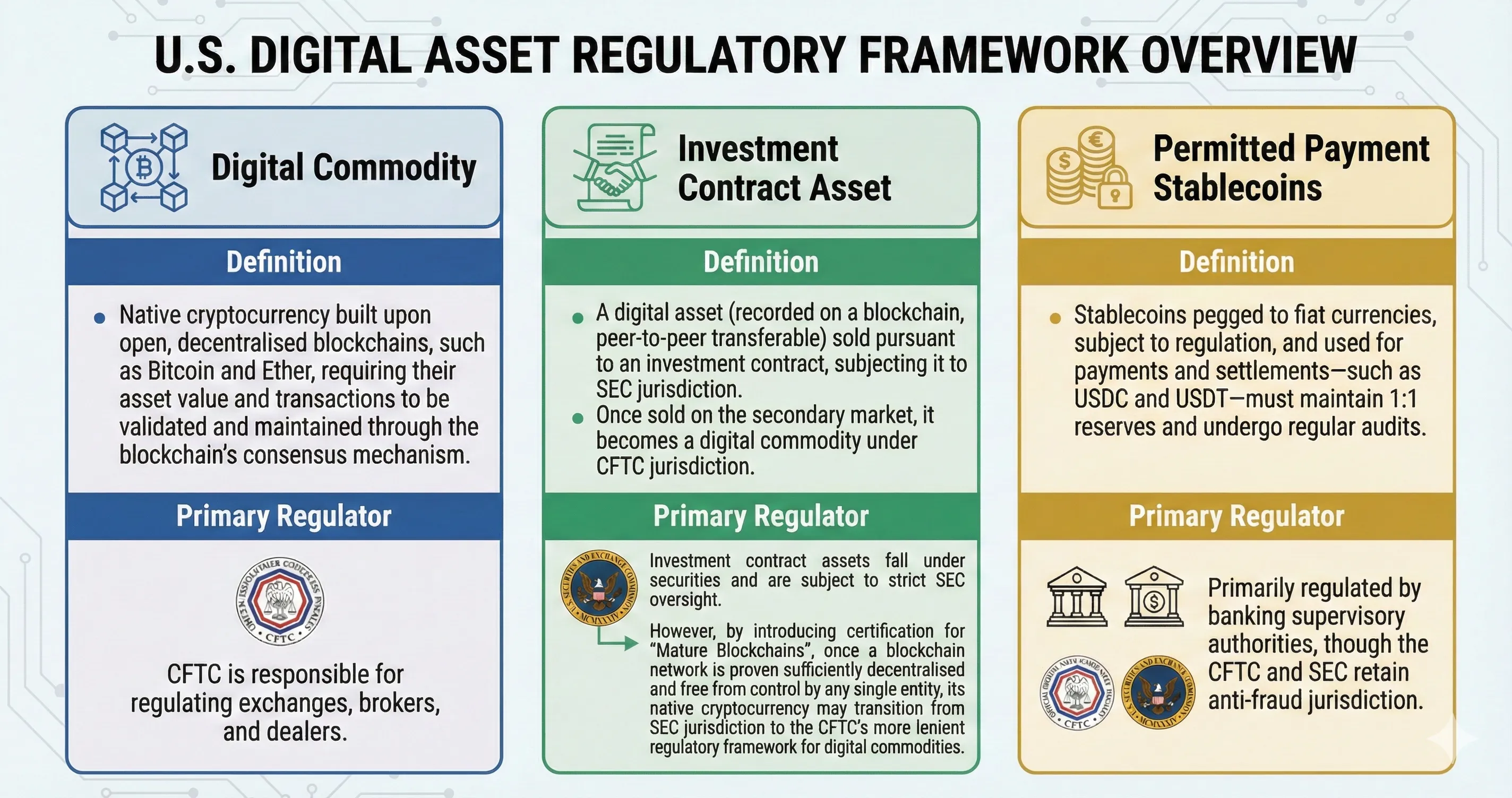
Digital Commodity |
Native cryptocurrency built upon open, decentralised blockchains, such as Bitcoin and Ether, requires their asset value and transactions to be validated and maintained through the blockchain's consensus mechanism. |
CFTC is responsible for regulating exchanges, brokers, and dealers. |
|
Investment Contract Asset |
A digital asset (recorded on a blockchain, peer-to-peer transferable) sold pursuant to an investment contract, subjecting it to SEC jurisdiction. Once sold on the secondary market, it becomes a digital commodity under CFTC jurisdiction. |
Investment contract assets fall under securities and are subject to strict SEC oversight. However, by introducing certification for “Mature Blockchains,” once a blockchain network is proven sufficiently decentralised and free from control by any single entity, its native cryptocurrency may transition from SEC jurisdiction to the CFTC's more lenient regulatory framework for digital commodities. |
|
Permitted Payment Stablecoins |
Stablecoins pegged to fiat currencies, subject to regulation, and used for payments and settlements—such as USDC and USDT—must maintain 1:1 reserves and undergo regular audits. |
Primarily regulated by banking supervisory authorities, though the CFTC and SEC retain anti-fraud jurisdiction. |
The Importance of The Clarity Act
1. Clarifying Jurisdiction
A longstanding challenge in the US cryptocurrency market has been the lack of a clear delineation between SEC and CFTC regulatory authority, creating grey areas that hinder compliance certainty and deter traditional capital from entering.
The Clarity Act will directly establish regulatory rules for US crypto assets, clearly distinguishing which virtual assets qualify as digital commodities versus securities. This will resolve jurisdictional overlaps and regulatory grey areas between the SEC and CFTC, providing greater legal certainty and compliance guidance for all market participants, and in turn helping attract institutional investment.
2. Establishing a Mature Blockchain Certification Scheme
Blockchain projects would be required to meet standards such as decentralisation and transparency (for example, no single entity holding more than 20%) in order to obtain Mature Blockchain Certification. This would exempt genuinely decentralised public chains from stricter SEC securities regulations, thereby further encouraging innovation.
3. Advancing Market Institutionalisation
The bill will explicitly permit traditional financial institutions, such as banks, to engage in virtual asset‑related business. At the same time, it will establish a new licensing category for “Digital Commodity Exchanges” (DCE), providing existing crypto exchanges and traditional exchanges (such as Nasdaq) with a clear regulatory framework for compliant operations. This includes provisions for anti‑money laundering and segregation of client funds, aiming to steer virtual asset trading towards a more transparent and regulated formal financial market and to attract substantial traditional capital inflows.
4. Providing a Convenient Gateway for Cryptocurrencies as Mainstream ETF Assets
Any cryptocurrency that becomes a primary ETP asset by 1 January 2026 shall be classified as a ‘non-derivative asset.’ This means cryptocurrencies, including Solana (SOL), Ripple (XRP), Dogecoin (DOGE), and Chainlink (LINK), will attain regulatory parity with Bitcoin (BTC) and Ethereum (ETH). They will no longer be classified as securities, exempting them from additional disclosure obligations. This provides a more straightforward pathway for these mainstream cryptocurrencies.
Market Impact of the Clarity Act
Previously, the market viewed January 2026 as a critical legislative milestone. However, the Senate Banking Committee has postponed the deliberation originally scheduled for 15 January 2026. While the Clarity Act remains a focal point for the cryptocurrency market this year, this delay may temporarily increase uncertainty regarding its passage. Nevertheless, the industry widely views the legislation as a positive long-term catalyst for the sector.
Undeniably, the Clarity Act defines a clear developmental trajectory for the US crypto market. By propelling virtual assets toward institutionalization, compliance, and mainstream adoption, it accelerates their integration into the broader financial ecosystem. This path of financial transformation is a trend that cannot be overlooked.
Source: The Clarity Act, Crypto Wesearch, MicroBit, 15 January 2026.
Disclaimers
This material is produced by MicroBit Capital Management Limited ("MicroBit") and is intended for Hong Kong investors only. All content is for general information purposes and does not constitute an offer, solicitation, or recommendation to buy or sell any financial instruments, nor is it legal, financial, tax, or investment advice.
Investments involve risks. The value of investments can go up or down, and investors may lose some or all of their invested capital. Past performance is not a guarantee of future results. You should carefully consider your investment objectives and risk tolerance and seek advice from a professional financial advisor before making any investment decisions.
MicroBit does not guarantee the accuracy, timeliness, completeness, or reliability of the information provided. All materials are presented “as is”, without any warranties of any kind, whether express or implied, including but not limited to merchantability, fitness for a particular purpose, or non-infringement. Unless otherwise specified, some of the views and recommendations are compiled by MicroBit based on publicly available data and market experience.
Securities and Futures Commission (SFC) authorization is not a recommendation or endorsement of a scheme, nor does it guarantee its commercial merits or performance. This material has not been reviewed by the SFC.
Copyright © 2026 MicroBit Capital Management Limited. All rights reserved.